
Should Bidirectional EV Charging Be Mandatory for New Cars?
Making bidirectional charging standard is only part of the picture. These companion guides explain how a suitable vehicle, a properly designed home installation and the wider electricity system can work together:
Explore the NRG EV and home-backup series
EV home backup and islanding: how a safe system works — a detailed guide with diagrams explaining isolation, equipment, source coordination and the questions to ask an installer.
Which electric cars can power your home? — a starting point for checking V2L, V2H and vehicle compatibility.
Could your electric car power your home during a power cut? — the emergency-power possibilities and practical limits.
Is electricity greener at certain times? — how flexible energy use relates to carbon intensity, tariffs and building performance.
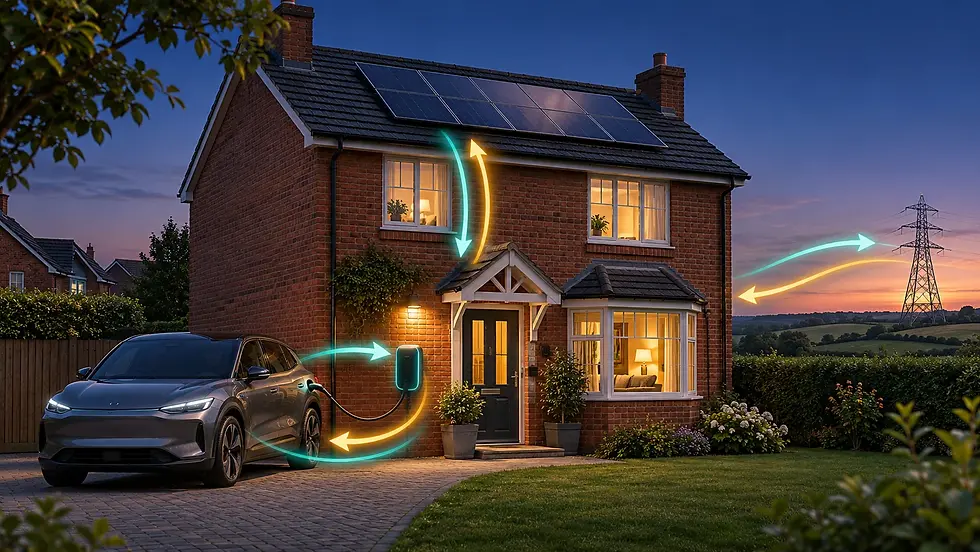
For many households, the largest battery they own could be parked on the driveway. Yet buying an electric car does not automatically mean you can use that stored energy to keep your home running during a power cut.
Should bidirectional charging become compulsory in all new electric vehicles? We believe governments should set a clear, phased route towards making it standard in new battery electric cars. Drivers should keep control over whether they participate, how much energy they share and when their car must be ready.
The opportunity reaches beyond emergency backup: a compatible car could work with your home, solar panels and the electricity grid, storing energy when it is plentiful and supplying it when it is needed.
What is bidirectional EV charging?
Bidirectional charging allows electricity to flow into an EV battery and back out again. Three terms describe different uses:
Vehicle-to-load (V2L): powers suitable individual appliances through a manufacturer-approved outlet or adaptor.
Vehicle-to-home (V2H): supplies household circuits through compatible equipment. Power-cut backup requires a system specifically designed for that purpose.
Vehicle-to-grid (V2G): exports electricity to the network through an approved installation and suitable commercial arrangements.
These features are not interchangeable. A car with an appliance socket is not automatically ready to power your house or export to the grid. Our UK EV compatibility guide is a starting point; confirm the exact model, trim, software and installation with the suppliers.
Emergency backup: safely islanding your home
During a storm or other electricity-supply disruption, an appropriately designed EV backup system could keep selected essentials running, such as lighting, refrigeration, communications and compatible heating controls.
The key is islanding: safely separating the backed-up installation from the public electricity network before supplying it locally. The ACT Government's guidance explains that home backup requires this safe disconnection.
A qualified installer must design the changeover, earthing, protection and circuit arrangements. A V2G system that exports while the grid is operating does not automatically work during an outage. Solar panels also need compatible backup equipment to keep operating when the grid fails.
Never feed electricity into household wiring through an ordinary wall socket. Home backup is a designed electrical installation, not a DIY cable connection. Read our guide to using an electric car during a power cut for more context.
How much emergency energy could an EV provide?
Consider an illustrative EV with 60 kWh of usable battery capacity, initially fully charged. Keeping 40% for driving leaves 36 kWh. Assuming 90% delivery efficiency gives about 32.4 kWh for household use.
At an assumed essential demand of 8 kWh a day, that is roughly four days of energy. This is arithmetic, not a promised backup duration: actual results depend on starting charge, vehicle discharge limits, standby consumption, weather and the equipment installed.
Energy capacity and power output are different. A battery may store plenty of energy but still be unable to run several high-demand appliances together. Electric space heating, hot water and cooking can use that reserve quickly. The vehicle must also be at home and connected.
Working with your home, solar panels and the grid
In a compatible system, an EV can absorb surplus rooftop solar while it is plugged in, then supply the home later. Coordinated charging can also move demand towards periods of abundant renewable generation; V2G adds the ability to send stored energy back when the network needs it.
The US Department of Energy identifies both building backup and grid services as applications of bidirectional vehicles. However, an EV cannot solve every network constraint. Benefits depend on where and when cars connect, local export limits and how charging is coordinated.
Financial savings are equally specific. Installation costs, import and export tariffs, conversion losses and battery wear all matter. A large battery alone does not guarantee a good return.
Keep the driver in control
A government-led standard should make useful controls easy to understand. For example, a driver should be able to request:
“Keep at least 40% available for driving.”
“Have the car at 90% by 7am tomorrow.”
“Charge to 100% before Saturday's long journey, following the manufacturer's advice.”
“Pause export and charge now because my plans have changed.”
These are illustrative policy requirements, not settings available on every current product. Actual vehicles and tariffs have different limits. Drivers should also be able to hold a larger emergency reserve when disruption is forecast.
Owning an EV should give you the option to support the grid, with transparent rewards and permission you can withdraw.
Are governments already taking action?
UK: incentives under consideration
The government's August 2026 ZEV mandate review consulted on manufacturer credits for vehicles with usable V2G or V2H capability. Its proposed criteria included enabled functionality, compatible UK charging equipment and warranty protection. This is a proposal, rather than a law requiring every new EV to be bidirectional.
The July 2026 Clean Flexibility Roadmap update also addresses bidirectional charging, interoperability and grid-connection barriers.
EU: better charging communication standards
EU Regulation 2025/656 introduces communication-standard requirements for specified new or renovated charging points from 1 January 2027. These help compatible systems communicate, but do not amount to a requirement that every new electric car can export power or provide home backup.
Other countries: practical government leadership
California's SB 59 legislation gives its Energy Commission authority to require bidirectional capability in vehicle classes where it finds sufficiently compelling benefits. The law itself is not an automatic blanket requirement for all EVs.
In Australia, ARENA announced AU$4 million in October 2026 for a project involving up to 130 ACT Government fleet EVs and bidirectional chargers. Public fleets offer a practical way to test grid support alongside everyday transport duties.
What should a bidirectional charging law include?
We support a phased requirement for new battery electric cars to offer functional bidirectional capability, backed by a wider government programme:
Usable compatibility: common standards, secure communications and clear information about which cars, chargers and services work together.
Clear backup claims: distinguish grid export from independently tested power-cut capability.
Consumer protection: explicit battery-warranty terms, understandable tariffs and control over driving reserves.
Affordable installation: proportionate network approvals, trained installers and support where costs block adoption.
Wider access: options for renters, flats, shared parking and households without driveways.
Manufacturers need a realistic transition period, and costs and technical exceptions need assessment. Requiring capability in new vehicles should not compel every owner to buy a home backup installation or join a grid-export scheme.
Our view: the battery should do more
Governments should lead this transition. Clear standards and a credible timetable could help manufacturers, electricity networks and installers build a system that works together.
A car's first job remains transport. But when it is parked and connected, giving its owner a safe choice to support the home and grid makes sense. Bidirectional charging deserves a place in the debate about energy security, renewable electricity and the next generation of EVs.
Bidirectional charging FAQs
Can every electric car power a house?
No. The vehicle, charging equipment and home installation must support the intended use. V2L appliance power alone does not establish V2H or V2G compatibility.
Will V2G work during a power cut?
Only if the complete system also provides suitable backup operation and safe isolation from the grid. Grid export capability alone is insufficient.
Does bidirectional charging improve an EPC rating?
Do not assume it does. An EPC uses an approved assessment method; an EV's battery capacity is not a direct measure of a building's energy performance.
Understand your home's energy performance
Backup storage works best as part of a wider plan for how your property uses energy. NRG Assessments provides domestic EPC assessments across Birmingham and the Midlands. Contact NRG to discuss your property's EPC requirements.
Policy and source information checked on 16 November 2026. This article presents NRG's policy view and general information, not an electrical installation design.


